
Adult Drum Classes for Beginners That Work
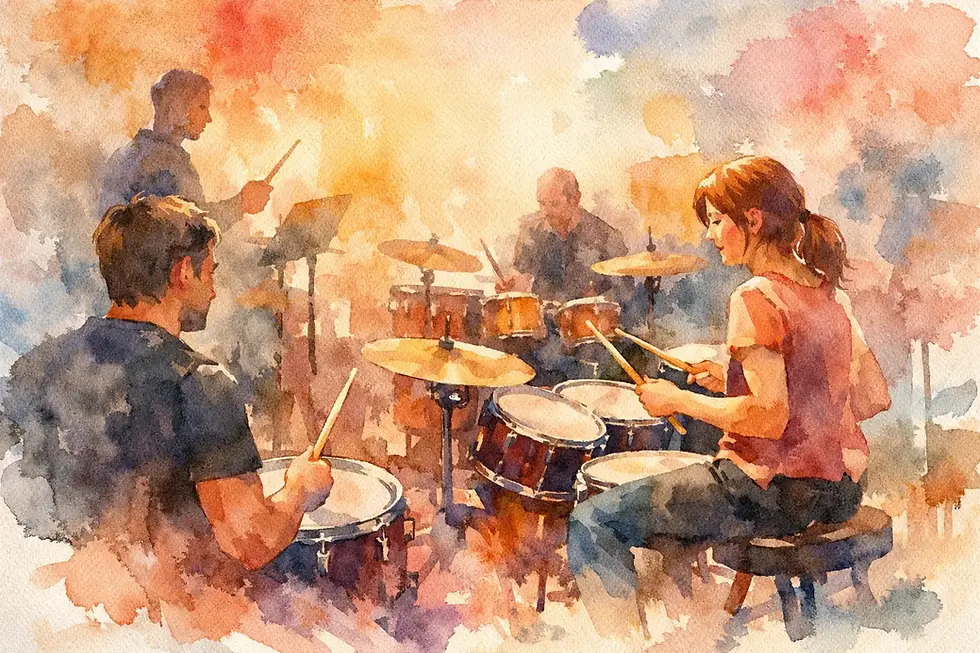
A lot of adults sit down at a drum kit for the first time with the same thought: I should have started years ago. The good news is that adult drum classes for beginners are built for exactly that moment. You do not need childhood lessons, natural talent, or perfect coordination to begin. You need a good teacher, a clear path, and enough patience to let your hands and feet learn something new together.
Drums are one of the most satisfying instruments to start as an adult because progress feels physical. You can hear it, but you can also feel it. The first steady beat, the first clean fill, the first time you play along with a song without losing time - those moments come sooner than many beginners expect when lessons are structured well.
Why adult beginners often do better than they think
Adults usually arrive with more self-awareness than younger students. That can create nerves at first, but it also helps learning. You are more likely to listen carefully, ask thoughtful questions, and notice where your timing slips. You also tend to value steady improvement instead of rushing for quick results.
The challenge is not ability. It is usually mindset. Many adult beginners worry about looking awkward, falling behind, or struggling with coordination. That is normal. Drumming asks your brain and body to split attention between counting, sticking, posture, and footwork. In the first few lessons, that can feel like a lot. With proper instruction, it becomes manageable because each skill is introduced in a useful order.
A supportive class environment matters here. Beginners improve faster when they feel comfortable making mistakes. Good instructors do not expect perfection early on. They focus on helping students develop pulse, control, and confidence step by step.
What good adult drum classes for beginners should include
Not every beginner program is truly beginner-friendly. Some lessons move too fast. Others stay casual for too long and leave students unsure whether they are improving. The best adult drum classes for beginners balance encouragement with structure.
That usually starts with fundamentals. A teacher should guide you through how to sit at the kit, how to hold the sticks, how to strike with control, and how to count basic rhythms. These are small details, but they affect everything that follows. If posture is off or grip is too tight, it becomes harder to play smoothly and harder to avoid fatigue.
From there, lessons should build around coordination and timing. Most adult beginners begin with simple grooves that connect the hi-hat, snare, and bass drum. At first, even a basic beat can take real concentration. A skilled instructor breaks it into smaller parts, helps you hear where the pulse sits, and gradually combines the limbs until the pattern feels natural.
Reading rhythm can also be useful, especially for adults who like knowing how music works. That said, it depends on your goals. Some students enjoy a more practical song-based approach in the beginning, while others like the clarity of notation right away. A strong program can do both - teaching you to play music you enjoy while still giving you the theory and reading skills that support long-term progress.
The first few months: what progress really looks like
Many beginners underestimate what they can do in a few months, but they also sometimes expect progress to be perfectly linear. It rarely is. One week your groove feels solid. The next week a small fill throws everything off. That does not mean you are stuck. It means your ears are improving and your standards are getting sharper.
In a structured lesson plan, the early stage often includes basic eighth-note grooves, simple fills, counting aloud, and learning to keep steady time with a metronome or backing track. You may also work on dynamics, which means learning to play with control instead of hitting everything at the same volume.
This stage is important because drums are not only about energy. They are about consistency. A beginner who can play a simple beat steadily is building a stronger musical foundation than someone who rushes into flashy fills without control.
As confidence grows, students usually start applying those patterns to actual songs. That is often the point where lessons become even more motivating. Playing along with music helps beginners understand structure, feel transitions, and experience what drumming is supposed to do - support the song.
Common concerns adults have before starting
One common concern is coordination. Adults often assume they are not naturally coordinated enough for drums. In reality, coordination on the drum kit is trained, not gifted. It develops through repetition, smart sequencing, and patient teaching. If your hands and feet do not cooperate at first, that is not a warning sign. It is the normal starting point.
Another concern is noise. That matters, especially if you plan to practice at home. Acoustic kits feel different from electronic kits, and each has trade-offs. Acoustic drums offer a more natural response and fuller sound, while electronic kits can be more practical for home practice. A teacher can help you work effectively with whichever setup fits your situation.
Some adults also worry about being older than everyone else. In a well-run academy, that should not be an issue. Adult learners need an environment where they are treated seriously, taught clearly, and encouraged at their own pace. Age-inclusive teaching makes a real difference because adults are not just bigger children. They bring different schedules, different goals, and different learning habits.
Why teacher quality matters more than flashy promises
For beginners, the teacher is often the difference between staying motivated and giving up too early. A good drum instructor does more than demonstrate patterns. They observe, correct, and explain. They know when to simplify something and when to push a little further.
This is especially important for adult students who may only have limited weekly practice time. If your lessons are focused, you can make meaningful progress even with a busy schedule. What matters is that the instructor gives you clear priorities instead of overwhelming you with too much at once.
The best teachers also understand that confidence is part of technique. When a student feels safe to ask questions and repeat basics without embarrassment, improvement tends to come faster. That kind of steady, instructor-led learning is one reason adults often do well in a structured academy setting rather than trying to piece everything together alone.
At MC Music Malaysia, this teaching approach matters because students are not simply left to guess their way through lessons. The emphasis is on enjoyable learning with visible progress, which is exactly what many adult beginners need to keep going.
Should lessons be casual, goal-based, or exam-focused?
It depends on why you are learning.
Some adult beginners want to play their favorite songs, relieve stress after work, and enjoy music in a new way. For them, lessons should feel practical and motivating, with enough structure to ensure real improvement.
Others like having clear milestones. Goal-based learning can be very effective because it gives practice a purpose. You are not just repeating exercises. You are working toward stronger timing, cleaner fills, better reading, or a performance target.
Then there are students who respond well to formal benchmarks such as graded music exams. This path is not necessary for everyone, but it can be valuable for adults who like measurable achievement and a clear curriculum. The right academy will help you choose a path that suits your pace rather than forcing one model on every student.
How to know a class is the right fit
A beginner drum class should leave you challenged, not confused. After a lesson, you should know what you are working on and why it matters. You should feel that your teacher noticed your playing and gave feedback that fits your level.
It also helps when the program is organized. Clear progression, consistent teaching quality, and a welcoming atmosphere are not small things. They are often what keep beginners enrolled long enough to see real results.
If you are a parent exploring lessons for yourself while choosing classes for your child, this matters even more. A school that teaches both young learners and adults well usually understands how to adjust pace, communication, and goals without losing quality.
Starting drums as an adult is not about catching up. It is about beginning well, building steadily, and enjoying the process of becoming more musical week by week. The first beat does not need to be perfect. It just needs to be the one that gets you started.


Comments